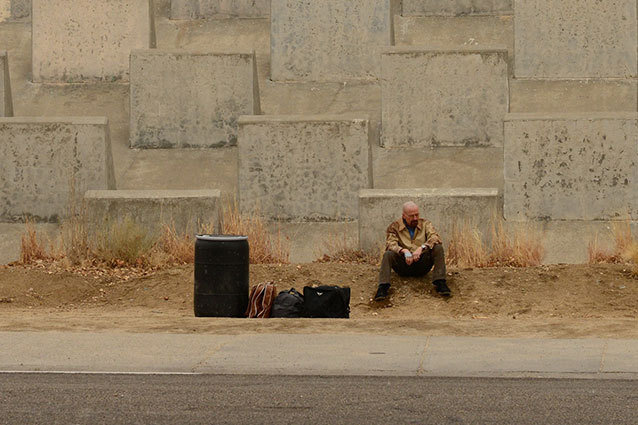
Monday, September 30, 2013

Breaking Bad Episode Review: "Felina" (S.5, Ep. 16)


Money is power.

The idiom has been passed around for years, however; does it mean to say that money creates power? Or, that money is powerful?

Both notions were prevalent concepts in the last 62 episodes of Vince Gilligan's "Breaking Bad".  Certainly, money equated to power, hence the drive by nearly every criminal character (i.e. Walter, Gus, Mike, Tuco, etc.) to gain fiscal rewards in search of power over their lives. For Walt, this was power over his cancer and his lowly teacher salary.  For Mike, this was power over his criminal background and his perpetual desire to do right by his granddaughter.

But then there's the other side of the idiom.  No pun intended, but the "other side of the coin".

Money is power-ful.

In "Felina", the gripping finale to "Breaking Bad", our protagonist, Walter White, hires two signature BB characters, Badger and Skinny Pete, to help instill fear in Walter's former business partners, Gretchen and Elliot Schwartz.  After the two rejoin Walter and return the laser pointers to the criminal genius, the two junkies (turned drug dealer, turned back to junkies) question the virtuous motives of scaring the Schwartzes.  "For real yo" says Pete, "Whole thing felt kind of shady.  Ya know, morality wise".

Silently, Walter hands the two characters two stacks of crispy $100 bills.  Instantly, Badger and Pete's qualms about their recent actions dissipate into the night's air.

Money is power-ful.

Badger and Skinny Pete are the lowest form of drug dealers we see in the duration of the five seasons of "Breaking Bad".  If Walter and Gus, are the top-echelon of drug dealers; these two gentleman are firmly stuck at the bottom of the totem pole.  However, the power of money drives Badger and Pete, but also Walter and Gus, to disregard their moral fiber in their relentless drive for more and more fiscal rewards.  Yes, (it is safe to say) money creates power, but more so, money is incredibly powerful.

Money is the wind in our drug dealers' sales.  It is the gas to their engines.  Heck, it is the methylamine to their crystal blue.

I have adjusted the classic idiom, "money is power", to fit within the context of "Breaking Bad", but also in connection with life and, nearly, any financial situation.  In my tweaking of this phrase, I continually would think of another expression, closely related to money, that was popularized in the early 1960's by the world's greatest songwriters.  On their sixth British single, the Beatles' sang, "money can't buy me love".

When Walter returns to Albuquerque to set things straight with those who have wronged him, it is the visit to Skyler's new home that prompted this song/expression to enter my mind in replace of "money is power-ful".  A broken Skyler looks ghostly in the face of her husband's return.  She has no desire for Walter's money and, certainly no desire for his love.

No, money cannot buy love nor happiness.  It cannot mend the massive tear that Walter creates for his family.  He attempts to use money to mend his situation between himself and Walt Jr. in "Granite City" (S.5, Ep. 15), but fails miserably as he sends his son into hysterics while he is taking a phone call in his schools' principal's office.  No attempt to fix any situation, connected to love and emotion, can be repaired through barrels, even bags, of money.

This begs the question, if money is an all powerful motivator, but it can't buy you love or happiness, what does money leave you with?

Sure, money can buy you fast cars, fancy clothes, massive yachts, beautiful homes, and more.

However, all tangible benefits aside, what does money leave you with?

As Walter White laid on the floor of Uncle Jack's meth lab, dying, he is left with no money and no love.  Instead, he is left to die in the reflection of the lab's stainless steel equipment.  There, in the literal location that represents Walter's talent; the location that represents Walter's passion; Walter's life ends.

All the money in the world couldn't fix Walter White's life.  It couldn't bring back Hank.  It couldn't ease Walt Jr.'s anger toward his dad.  It couldn't sway Jesse to accept Walter, despite his wrongdoings.

When Walter returns to Skyler for the last time he reflects on his actions saying, "I did it for me.  I liked it.  I was good at it.  And I was really...I was alive".

Walter obviously cannot take his money with him when he dies and his money had no place on mortal earth.  It is here, finally, that we realize that the thing that motivated Walter was not money.

When Walter wanted to pay his bills and when he wanted to be apart of the "enterprise business", it appeared that money was his driving force, but the reality is that something much more powerful than money drove Walter.  Instead, what drove Walter White and Heisenberg, alike, was Walter White.

Money drives lowly drug dealers to overlook their morals and shoot laser pointers at wealthy benefactors.  Therefore, there is something more powerful than money that drives characters like Gus and Walter to the means they choose to achieve their preferred ends.  Their desire for money cannot explain it.  Their desire for power is not the answer.  Their desire for love is simply not logical.

What drives Walter? And, what does money leave you with?

The answer to both questions is the same...

Your talents.
Your passions.
You.

Wednesday, September 25, 2013

Nirvana: A Generation’s Band and a Band’s Generation


Scribbled across one of his many notebooks, Kurt Cobain had started a list of possible band names.  “Poo-Poo Box”, “Whisker Biscuit”, “Skid Row” and “Fecal Matter” were all available options for Cobain’s newly formed grunge rock band. Twenty-five years removed from the discussion of what to call themselves, Cobain, Krist Novoselic and Dave Grohl would go on to sell over 10 millions records under the name, Nirvana, and be heralded as pioneers and legends in the rock and roll community.  Questions about whether the band would have succeeded had they kept the name “Fecal Matter”, or instead gone with “Poo-Poo Box”, still are asked by fans today.  However, while the band name “Nirvana” is far more marketable than the other considered options, the realities of Nirvana’s success lies in the band’s musical ingenuity and their unique relationship to their fans.  What makes Nirvana so prolific in American music history is their affiliation with Generation X, a generation of youth born from 1960 to 1980, and their place in history as the Generation’s flagship band.  Nirvana would go on to define the newly emerging grunge music scene and popularize the genre internationally, but the special relationship between a band and a whole generation lies within a deeper understanding of both Generation X and Nirvana.  To understand Nirvana’s importance to Generation X, one must truly understand Generation X.  To understand Generation X’s importance to Nirvana, one must truly understand Nirvana. The focus on this essay is not to provide information on one of these two topics, but rather aims to display the important relationship between the two.  It is a cycling relationship, but when the realities of both Generation X and Nirvana are exposed, a greater understanding of the significance of Nirvana in the narrative of American history can be achieved. 
         

Generation X is the term used to describe the generation of people born from 1960-1980 and is considered to be the generation that followed the post-World War II Baby Boomer Generation.  The very terming of a Generation X marks a symbolic change in America’s youth as it clear that those born in the early 60’s are markedly different than members of the Baby Boomer Generation, which is comprised of people born in the early 1950’s.  However, the historical context of the 50’s versus the 60’s allows for glaring differences in both the cultural perspectives and political experiences of America’s youth.  Youth of Generation X grew up in the light of the Watergate Scandal, the end of the Cold War, and during the transition from the tribulations of Black Monday to the fruitfulness of the 1990’s Economic Boom.  However, political and economic events were not the only formative events to occur for X’ers. Social trends including the increase of divorced parents, bullies in school and teen drug use also played a role in shaping Generation X.  In a collection of essays on Generation X, Professor Christine Henseler summarized the generation as, “a generation whose worldview is based on change, on the need to combat corruption, dictatorships, abuse, AIDS, a generation in search of human dignity and individual freedom, the need for stability, love, tolerance and human rights for all”.[1]  Clearly, Generation X was different than its preceding Baby Boomer Generation and the differences created a blatant disconnect between the two generations.  What was once normal, popular and appropriate for the Baby Boomer Generation would simply not be the same for the newly emerging Generation X.  It would be this generation that would claim Nirvana as a flagship for the generation and it is the very same X’ers who would dub Kurt Cobain their spokesperson.           

Monday, September 23, 2013

Breaking Bad Episode Review: "Granite Slate" (S.5, Ep.15)


Last night was a busy night for TV, literally.

The 65th annual Emmy Awards aired yesterday evening.  The award show celebrates all that is great in the world of TV.  As a TV nut myself, I do sincerely enjoy the Emmy's, however; the Bears were playing and while I love television shows and NPH, I simply prefer watching Marc Trestman (aka. Willy Wonka) and Da Bears.

I will note, the Emmys did create an impetus for me to think about some of my favorite TV programs and their relationship to my current favorites (i.e. "Breaking Bad", "House of Cards", "Parks & Recs").  Edie Falco's tribute to the late James Gandolfini made me remember the greatness of "The Sopranos"; Ed Helms made me remember the hilarity of "The Office"; and Tony Hale, winner of Best Supporting Actor in a Comedy Series, made me remember "Arrested Development" and how he will always be Buster Bluth.

Yes, the Emmys jogged my memory and, as soon as the Bears' game had ended, it was time to tune into this week's episode of Breaking Bad, "Granite City".

Maybe it was the Emmys that provided this memory, but all I could think about at the end of "Granite City" was HBO's "The Wire".  I recalled a brilliant scene where Marlo Stanfield, Cheese, Monk and Chris are all incarcerated in a Baltimore prison cell (S.5, Ep.9).  Monk informs his fearless leader, Marlo, that Omar has been calling out Marlo, saying that Marlo needs to be out on the streets and needs to face Omar for killing Butchie.

"My name is on the street?", Marlo asks.  Fearful that he has lost his grasp on the streets and the authority he commands on them, Marlo remarks, "Let them know Marlo will step to any mothaf*cka.  Omar, Barksdale, whoever.  My name is my name."

In an emphatic rage, Marlo expresses that his name and his reputation are everything.  Without it, he feels worthless.  Without his name, whether he is on the streets, in jail, or, even, dead; his name and reputation mean everything.

This scene, this monologue by Marlo Stanfield, was all I could think about after the end of "Breaking Bad" yesterday evening.  Walter White, like Marlo, watched as his former colleagues belittle not only his contributions to Gray Matter Technologies, but his name.

Walter White aka. Heisenberg will return to Albuquerque to take care of his unfinished business in New Mexico in Breaking Bad's series finale.  The motive behind his return?  It must to be to fix his reputation and to regain his name.

"My name is my name."

It's a simple, yet entirely complex, phrase.  The meaning is not blatantly evident, rather; it forces the reader (or listener) to assess what someones' "name" really represents.

For Walter White, his name represents his role as a father and member of the White family.
For Heisenberg, his name represents his role as the greatest drug kingpin, ever.

Whatever name Walt plans on restoring the reputation of is up to Vince Gilligan.  The answer of which name he will work to restore lies in the pages of the script titled, "Felina".  However, whatever name Walt plans on restoring, whatever reputation he plans on reestablishing; we know he will do it with force and with the cunning wit that only Walter White (or Heisenberg) can deliver.

I am unsure whether Walt will die or live in the series finale of "Breaking Bad".
I am unsure whether Walt aims to restore his name as Heisenberg, drug kingpin extraordinare.
I am unsure whether Walt is truly done with "Heisenberg" and, now, aims to restore his name as Walter White, the husband of Skyler and father of Walter Jr. and Holly.

"My name is my name."

I do know this much- our lovable chemistry teacher turned drug lord will most certainly not be ending his tenure on "Breaking Bad" as Walter Lambert.  No, instead Walt knows this pseudonym will not suffice.  He knows what his name means or, at least, what it used to mean.

His name is his reputation.
His name is his legacy.
His name is his name.

Friday, September 20, 2013

Album Review: "Nothing Was The Same" - Drake


A lot has changed for Drake.

It has been twelve years since he first appeared on MTV's "Degrassi"
It has been five years since Lil' Wayne first was given a few of his records to listen to.
It has been a two years since the release of his debut album, Thank Me Later.
It has been seven months since his sophomore album, Take Care, won Rap Album of the Year at the 55th Grammy Awards.

Since surfacing in 2009 with his So Far Gone mixtape, Drake has also been the target of plenty criticism.  His previous role on Degrassi and current status as a "rapper" has given way for fans and critics alike to call Drake "fake" or "soft". Surely, a teenage actor turned rapper is going to turn heads and draw criticism in a genre where the most common job for emcees before their rap career launched is subjected to a street corner rather than on a film set.

On Drake's latest album, Nothing Was The Same, Drake delivers a level of honesty that has forced listeners (even myself- someone who never was perturbed by his background) to overlook his past in order to effectively understand his present status.  His third studio album is overbrimming with honesty so much so that the persistent theme seems to finally address the perpetual criticism and scrutiny the Toronto rapper has faced since the release of So Far Gone.

On the album's opening track, "Tuscan Leather", Drake delivers three separate verses divided by no chorus, but minor changes in the song's beat.  In the opening verse, over a beat that sounds like it belonged on a Diplomats record, Drake raps, "I'm just as famous as my mentor".  By being blunt as possible on the opening verse of the album's first song, Drake is acknowledging that his fame has surpassed that of his mentor, Lil' Wayne; whose slipping fame has manifested in the recent flop of his Truckfit clothing line and sub-par download numbers on his latest mixtape, Dedication 5.  Two minutes into the album and Drake has already divulged an honest, yet controversial, personal thought with his listeners.  He has showed his listeners what he thinks about himself and how he feels about his current status in relationship to his past.

It's hard to review Nothing Was The Same and remember that the album's singles, "Started From The Bottom" and "Hold On, We're Going Home" are even singles at all.  "Started From The Bottom" started off the 2013 and has had the most influence on pop culture since Jay and Kanye's "N*ggas In Paris".  "Hold On We're Going Home" was out for less than a month and has already amassed more radio play than any song from either of Big Sean and 2 Chainz's recent studio albums.  There's no question that these singles are valuable pieces of Nothing Was The Same.

For "From Time" and "305 to My City", Drake passes the vocals over to Jhene Aiko and Detail, respectively, having the two artists forge the song's impressive choruses.  In an album that feels overwhelmingly dominated by Drake's singing skills, these two tracks stand out as two moments where Drake passes the microphone over to another skilled musician, beside himself, for a songs' chorus.  (Don't miss  the ultra-talented Jhene Aiko on "From Time").  The album's only major rap feature comes from Jay-Z on "Pound Cake" where Jay bogs down a mediocre verse with celebrity name drops ranging from Katy Perry to William Wesley.  Jay's verse seems to be a continuation of the average lyrics on July's Magna Carta Holy Grail.

However, Drake certainly includes tracks where he does both the singing and the rapping.  Adhering to his signature style, Drake delivers melodic choruses and metaphor laden verses on "Own It" and "Furthest Thing".  Both tracks have that signature Drake feel to them and are some of the album's lighter moments.

The album's strongest tracks, "The Language" and "Too Much", are undoubtably the stand out pieces from the emcee's third album.  On "The Language", Boi-1da (the same producer behind previous Drake smash-hits such as "Best I Ever Had", "Over" and "Take Care") crafts a beat that perfectly echoes Drake's verses and melodic chorus.  The classic Drake flow feels as fresh as the first time we heard it and "The Language" is complimented by Drake's easy transitions from singing to rapping, back to singing.  On "Too Much", the album's nicest track, Drake samples a song by Sampha, the vocalist behind "The Motion" and internet hit "Wildfire (Remix)".  Sampha's chorus is looped throughout the song and is an excellent pairing to Drake's finest bars.  Looking for honesty? Drake raps about his fear that no one would show up to his 2009 show at The Warehouse, a popular Houston concert venue.  (Drake sold out the venue two nights in a row during his recent tour).

It's clear.  Drake is not going to over evaluate his past, like so many do, and instead is going to keep it as real as he can.  Like he said on 2 Chainz's 2012 summer hit, "No lie".

The clearest acknowledgement toward the critics comes on "Worst Behavior" where Drake's aggressive flow mirrors that of his previous "Versace" and "Stay Schemin" verses.  The track is a huge F-U to the critics who decided to label Drake as "soft" and "fake".  Rapping about the bitterness of critics, Drake remarks "Mothaf*ckas never loved us", nearly replicating Ma$e's verse on "Mo' Money, Mo' Problems".  In addressing these critics, Drake seems to not care as his near-violent bars could literally be equated to spitting in their faces.

It's clear.  Drake doesn't want to over evaluate his past like so many do.  He instead wants to deliver an insight into the honest and true life of Aubrey Graham aka. Drake.  This idea is most evident on "Wu-Tang Forever" , discussing the streets and the gang lifestyle that so many emcees in the genre have been acustomed to since their earliest years, Drake notes "Luckily I didn't have to grow there/ I would only go there cause niggas that I know there".

No lies.
No faking.
Just honesty.

Drake uses Nothing Was The Same to finally face the growing critics and scrutinizers.  He has no reason to lie to listeners and appear as "soft" or "fake".  Instead, he is revealing what his life is really like.  What he really experiences and what he really has experienced.

A lot has changed for Drake.  Just look at the last twelve years for the Toronto rapper.  Honestly,


Nothing Was The Same.


All links courtesy of the good people at Rap Genius aka. The Rap Game's Torah.

Monday, September 16, 2013

Breaking Bad Episode Review: "Ozymandias" (S.5, Ep.14)


I am a big fan of nostalgia.  

Let me be clear, this does not mean I am a fan of the overly-nostalgic lists Buzzfeed has been putting up on their website over the last six months.  That is not nostalgia.  I've seen the lists. "How Great it was to be a Kid During the 90's" or "How Being a Middle Schooler in the 21st Century was the Best Time to be a Middle Schooler".  These lists (or running stream of pictures from our pasts with quirky one liners and captions) are not nostalgia. No, instead these lists are a sad attempt at creating this unique emotion in their readers.

What is nostalgia? Nostalgia is when you yearn for the pass, not just when you miss it.  It's a sentimental longing or a wistful affection for a time period in the past.  When I look at a Buzzfeed lists and I see a picture of a Motorola Razr I don't feel nostalgic.  I don't suddenly wish I could swap my iPhone and all its apps for 2003's premier cellphone.  Now, if I wanted to revert back to a Razr, that would be nostalgia.  However, since I am more far more content to stick with my iPhone, these lists and their pictures are just a glimpses of a memory from an earlier time. 

Lately, Breaking Bad has pulled on my desire for Nostalgia.  It might be that I recently re-watched the show's earlier seasons or it might be that the show has taken such a tailspin from its earliest days.  Regardless, the opening of Vince Gilligan's latest masterpiece, "Ozymandias" immediately plays on my recent nostalgic feelings.  The previous episode ended in a shoot out.  This episode opened with a flashback to the pilot episode of BB.  A flashback to Walter and Jesse's first cook, in the exact spot where the bone chilling and ever-climactic shoot out of episode 13 occurs, is brilliant.  The footage of a Walter formulating and delivering the first of many fibs to a clueless Skyler is flawless.

The feeling that overtook me in this opening scene was true and honest nostalgia.  I yearned for those moments.  For Walt, for Jesse, for Skyler.  Things were much more simple for our characters at the time of this flashback.  

Walter had hair.
Bogdan still owned the carwash.  
Jesse still wore beanies and baggy hoodies.  
Vince Gilligan's scripts had not yet included the killing of a single character.  

The simplicity of my favorite characters' lives in the pilot episode made me wishfully remember their lives at the time of the flashback.  To a time, merely one year earlier, in the very same location, where Walter had first started to "break bad".  Where Walter still needed to lie to Skyler to hide his actions (rather than threaten her life by swearing he'd kill her, the same way he did Hank, if she crossed him).

The following scenes created an even more magnified sense of nostalgia.  With the quick pull of a trigger, Hank Schrader was gone.  The character who had once provided continual comic relief and occasional racist remarks to an otherwise dark and morbid TV show had been killed like many characters before him.  At no point before the death of Hank did I ever wish the characters of Breaking Bad could go back to the time period where we first met Walter White & Co.  

Before Hank knew about blue meth.  
Before Hank knew about Gus Fring.  
Before Hank knew about Walter's involvement.  
Before Hank knew Uncle Jack had already decided to pull his gun's trigger.

This, my friends, is nostalgia.  The powerful desire to go back to a different time period.  The problem with these Buzzfeed lists is that they simply lead viewers to revisit a simpler time in their mind.  However, these time periods, more simple or not, are not more desirable than our current state.  The current state of Walter, of Jesse, of Skyler, of Marie, of Hank; these are not simpler times.  Instead, the moments from the opening flashback in "Ozymandias" are the times we truly wish our characters could just go back to.

Gilligan knows the power of nostalgia. Of real nostalgia.

The emotions I have allowed to develop within me since those earliest scenes have now manifested in a nostalgic yearn to return the lives' of Breaking Bad's characters to a different time.  These building emotions have created the perpetual desire that things could revert back to an easier time as quickly as they went array for our characters.  These desires are unrealistic, but that's one of nostalgia's greatest powers.

It makes you want something that is, well, impossible.  

Walter White will make his return to Albuquerque soon.

To the house he raised Walt Jr. and Holly in.  
To the house where he had an emotional break down in his crawlspace.  
To the house where he cultivated a Lily of the Valley plant to poison Brock.  
To the house where things were, once, simpler.

Will it be nostalgia that wills Walter back home? Or, will it be the need to address unfinished business?

The massive machine gun in his trunk from Season 5, Episode 1 seems to hint at the latter, however; we know the power of nostalgia and the influence it has on all of us.  Character and viewer alike, nostalgia can overtake us and make us want something that very well is entirely unrealistic. Nostalgia won't just create a faint memory of an earlier time, but will instead create a burning desire to return to the time of the memory.  

In the opening scenes of Season 5 we see Walter seated at the bar of a Denny's restaurant. Walt tells the waitress that he is celebrating his 52nd birthday and, in doing so, begins rearranging his bacon strips into the number 52.

I have to wonder.

What has Walter White feeling nostalgic?